Enrichment for Your Furry Companion

Does this ring a bell?

I thought the best way of helping Jack learn to relax was physical exercise.

Running or walking him, in my mind, was the only way for him to just chill.

Boy, was I wrong.

Exercise has it’s part as it encourages bonding with you and increase in fitness, but mental stimulation is so important for an overall wellness plan for your dog.

Here are 6 Canine Enrichment areas and ideas you can include into your dog’s routine.

⭐️ Sensory: Anything that can enliven your dog’s sense of taste, smell, touch, sight and sound. Building a sensory garden in your yard by adding a elevated digging pit, add a kiddie pool and you can fill with either water or switch it out with balls. Add in non toxic plants and ornamental grasses for your dog as some ideas. Even using music through platforms of ICalm by pairing with a carefully planned out D/CC approach to triggering stimuli can help change your dog’s emotional response to those triggers.

Sensory garden: https://www.hgtv.com/lifestyle/family/pets/sensory-dog-garden

⭐️ Feeding: Get rid of the food bowl and try some scatter feeding in your yard or even use a snuffle mat. Foraging also activates your dog’s sense of smell (which is their prominent sense 10s of thousands times stronger than humans). You can even include Find It games or roll up a towel as you sprinkle some of their meal into each roll. Even using a lickety mat can encourage your dog’s change of mind to once fearful experiences. This also adds some different textures which also incorporates a sensory experience.

⭐️ Toys and Puzzles: Teaching your dog games like tug work in other areas of enrichment like training and social interaction. Learning new ways of solving a problem raises confidence as well as a deep sense of relaxation. Also, make sure to teach your dog giving breaks during play is also desireable so your dog enjoys settling and resetting. This also builds in meeting the social needs of your dogs too.

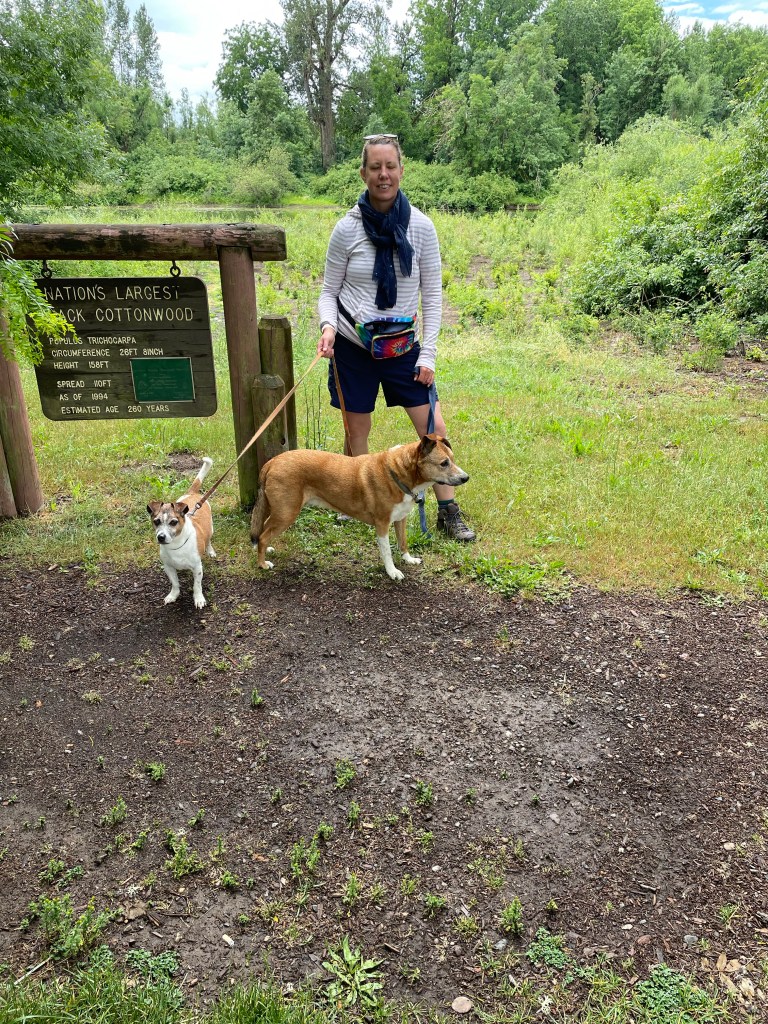
⭐️ Environmental: Change of scenery can enhance your dog’s life just like us. Consider exploring a new hiking spot as a staycation for your dog. Exploring new environments is exciting as well as perfect bonding trip with you. Adding in a decompression walk with a long line can also give your dog some level of freedom to sniff about and take in the experience.

⭐️ Social: Bonding with you is the best! Also, if your dog enjoys being around other likeminded playmates and expresses shared play styles, schedule regular play dates. This can keep the play skills sharp, but work in a little exercise too.

⭐️ Training: Teaching your dog new cues and even incorporating cues like settle can help our dogs take breaks during play sessions, so your dog or a friend’s dog doesn’t become overly stimulated preventing play from becoming too intense.

Olive starting off with the basics on SUP!
Snuffle mats and DIY puzzle games

Opportunities for Choices

“I can see her making choices.”

During a training session, a client made this observation.

His dog was able to disengage from someone approaching which is usually a very exciting situation leading to his dog jumping up on the person.

Instead, with an established reinforcement history, she made a different choice of looking back at my client even when she started to become a little excited.

She also had her needs met of getting attention from one of her favorite humans.

Teaching your dog what you want sets your dog up for making choices in her environment.

The choices you want are established through a strong reinforcement history.

You go through each step at a time.

Building your dog’s self control capabilities.

As you begin seeing what your dog is offering as something of value, you can quickly signal the value to your dog.

Being patient, waiting for the environment to change, observing what your dog is communicating through the changes of your dog’s body language, you can then become aware what your dog is offering and begin seeing your dog making the choices you want.

The choices of looking at you, looking away from the trigger will inhibit the emotional response of the barking and lunging out of fear or frustration will be replaced because your dog is feeling safe in the

environment.

Engage/Disengage

When your dog is relaxed, your dog can offer the choices of staying engaged with you.

Engagement with you, is the goal.

Chaos to Calm

Bernie enjoying some attention.

When you’re frustrated with your dog’s barking and lunging, you may be unable to empathize with your dog’s emotional experience of the environment.

Your own learning about what is going on beneath the surface of your dog’s outward expressions can give you understanding of how your dog is experiencing the world around him and help you see your dog is struggling rather than being difficult.

Feeling fear or frustration are some things your dog may be experiencing and the outward expression is barking and lunging.

When your dog experiences fear, this inhibits your dog from seeking pleasure which in turn limits your dog’s learning.

Your dog is emotionally flooded and doesn’t trust he’ll be safe.

First, help your dog regain trust that the perceived or real threat is no longer one.

You can do this by moving you and your dog away from what the triggering situation or event is.

This will decrease the intensity of the trigger which will decrease your dog’s perception of feeling threatened.

Then you will want to desensitize whatever causes your dog’s fear (person or another dog or a truck driving by) so your dog can change his emotional response to each stimuli.

Pairing at a distance (lessens the intensity) the trigger with what your dog finds out of this world pleasurable (most often this is a high valued food item(s)).

Using the Open Bar/Closed Bar method, when something that causes your dog considers to be fear inducing, give the reward in rapid succession or play with your dog while the person or other dog are in view. When they go out of view, immediately stop.

Repeat.

You can also teach your dog an alternate behavior of looking back at you. Once you’ve made the reward marker (a click, a verbal yes/good) reinforced, your dog will offer a head turn towards you when he hears the reward marker.

So, when your dog is looking at the other person, or dog from a distance, say your reward marker or click and when your dog turns his head towards you (the behavior), reward!

As your dog remains comfortable and relaxed (watch body language), slowly decrease the distance to those triggers.

Remember to practice your defensive leash handling for those surprising situations!

Inside your home is a bit of a different story.

Keep in mind, you don’t have a responsibility to fulfill the needs of others wanting to interact with your dog. Teaching your dog to be in his safe zone away from certain guests will ensure your dog is safe and the particular guest is safe too.

Also, not all people want to be around dogs either. Some guests may be time limited like a maintenance person, so management may be a better solution for these types of experiences.

Teach your dog to love hearing the sound of the doorbell!

Teach your dog to settle and relax on a mat with distractions.

Teach your dog to wait.

Teach your dog all four on the floor is way better than jumping up and saying “hello”!

Jack is always ready!

These are a few, what else can you think of that you want your dog to learn?