BAT Effectiveness

A couple of weeks ago, I published Take a Breath and Reset Your Mind where I discussed Jack’s progress and my expectations for his continued growth.  Briefly, I mentioned how I brought Jack into a training session with a reactive dog named Sadie.  Well, Jack did his job and him and Sadie played.

A bit of background on Sadie.  Sadie is a Boxer.  I first met Sadie at the Humane Society of El Paso where I volunteered several hours a week at the time.  Sadie was surrendered by a couple of different families because they didn’t feel Sadie could be around other dogs. While at the Humane Society, she was sweet and enjoyed being with people.  When Linda talked about her love of the Boxer breed, I shared there are Boxers at the Humane Society.  And what do you know, Linda adopted Sadie!

Sadie’s reactivity prevented the possibility of her being social and greeting another dog.  As a smart and dedicated woman, Linda ensured Sadie’s safety and remained cautious when walking Sadie as she would often lunge, crawl, dart or do whatever in an attempt to meet another dog.   After Sadie settled into her new home, Linda and I set up training.

The first things the three of us worked on were basic obedience.  Sadie is extremely food motivated, so this came in handy.  We worked on sit, down, stay, down/stay, focus and loose leash walking.  Out of all of these, focus was the most important as a preliminary step in Behavior Adjustment Training (BAT).  The reason, focus was the behavior which took the attention away from a distraction and brought attention right back to the handler.  Sadie’s energy in training was so great.  She learned quickly and stay motivated.  Linda also continued practicing with Sadie during the rest of the week and it showed.  After several sessions, it seemed to me Sadie’s progress was starting to plateau and I immediately thought of bringing Jack in for Sadie’s BAT training.

What is Behavior Adjustment Training?  Essentially, BAT is working below a dog’s threshold to a particular trigger and reinforcing replacement behaviors such as sniffing the ground, looking away, moving away and focusing on the handler when a trigger is present. The goal being changing a dog’s emotional response.  Threshold training means working at a point below where the dog becomes noticeably stressed.  Once at the point of a dog barking, lunging at the trigger, its vitally important in moving the dog farther away since no training can happen at this time. The dog is too far gone in reacting to the trigger.  Once the handler determines when a dog can remain relatively relaxed and practice the focus cue or sees other replacement behaviors and reinforces them, then the handler can slowly decrease the distance to the trigger all the while keeping the dog relaxed.  The focus cue (look at me, watch me can all do the same) reorients the dog to the handler and the dog is reinforced after looking the handler in the eye.  This is implementing a replacement behavior on cue.   For more in depth understanding on BAT, check out: “Behavior Adjustment Training: BAT for Fear, Frustration and Aggression in Dogs” by Grisha Stewart.

The day came for Sadie and Jack’s first meeting.  Since Sadie is reactive and being out for a walk may be too distracting and a bit overwhelming for her, Linda and I decided for the two dogs to meet in Linda’s backyard.  Both Jack and Sadie were on leashes (which was a difficult consideration, but one where both Linda and I remained in control).  As Jack entered the backyard, Sadie was whining, barking, lunging and completely fixated on Jack.  She was unable moving away or showing any replacement behaviors.  She was locked in!  Jack didn’t match her energy.  He ignored her, worked on obedience training with me and moved away with ease.  Jack and I would move towards them at a safe distance and once Sadie started reacting and lunging, Jack and I swiftly moved far away.  We continued working in this fashion.  As the session progressed, her energy towards Jack began decreasing and she began sniffing the ground and turning away from him.  As soon as she would, Linda would praise her for those behaviors.  Sadie showed progress, but still not enough for them working on greeting behaviors.

The second session, a week later, we saw such progress!  When Sadie and Jack were introduced again, Sadie did show stress, but her ability in doing replacement behaviors increased and she was able to do the focus cue when Linda asked.  The progress made was amazing and reinforced for me the effectiveness of BAT.  Even Jack was more comfortable, as soon as training was done, he gave a play bow!

Finally, by our third session with Jack, Sadie seemed even more relaxed.  She ignored Jack more, looked away from him and the two of them were able to lay side by side with a few feet apart for a few seconds at a time.  Remembering Jack giving the play bow last time, I felt we could move their introduction along. Luckily, Linda has a baby gate which she used for Sadie.  I put Jack in the kitchen and baby gated Sadie in the dining room.  The gate served two purposes.  The primary, it was a barrier for both dogs while allowing both dogs to see and sniff each other without being able to get to one another.  The second purpose, it allowed both Jack and Sadie roam free without leashes.  As you may know, leashes, especially, tension on a leash often causes tension in a dog which then translates into reactivity.  The ability for both Jack and Sadie having the freedom allowed for more relaxed approach in their first meeting.  Linda and I practiced obedience training with both dogs as they were separated.  Linda also crossed over the barrier and sat with Jack in the kitchen and Sadie didn’t show any stress.  After about 15 minutes and Jack jumping on the gate, Sadie and Jack met.  Let me tell you, it was awesome.  Jack immediately picked up one of Sadie’s toys and started running around the couch and Sadie began chasing him.  She allowed him to take a toy out of her mouth and playing ensued.  There were moments where Sadie’s body language became rigid and frozen.  I made sure to interrupt this behavior since this is indicative of more aggressive action about to possibly take place.  I then rewarded the replacement behaviors which happened in response.
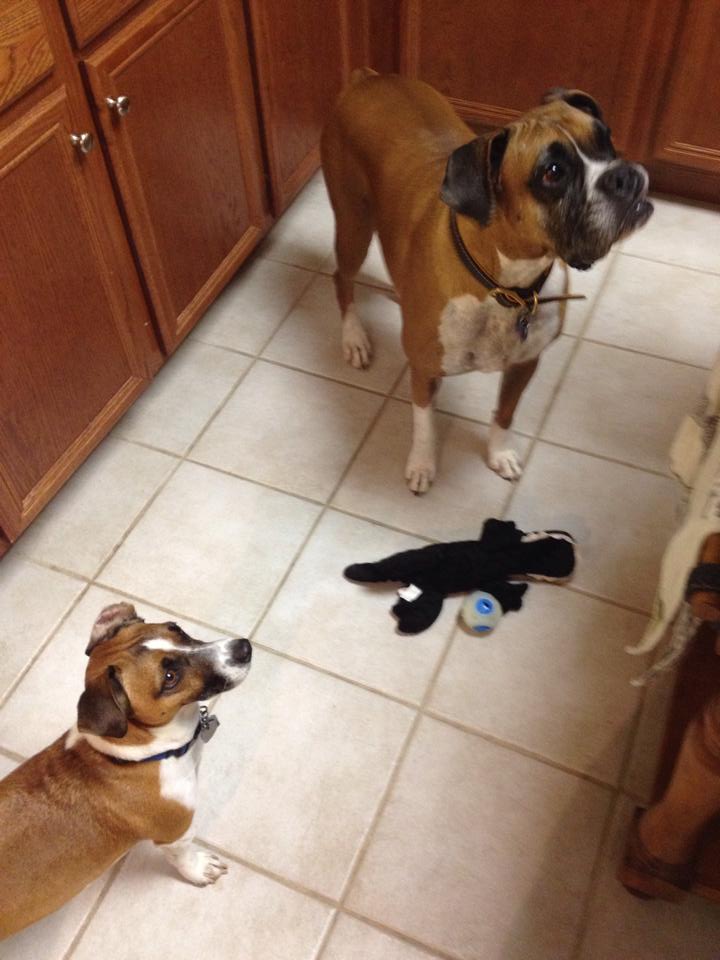
Courtesy of Linda S, Sadie's mom :)
Courtesy of Linda S, Sadie’s mom 🙂 Jack and Sadie after some play time.

BAT is a useful strategy in changing a dog’s emotional response about a stressful trigger.  Its done in time with how quickly or slowly the dog works and progresses and should not be rushed.

If you have a reactive dog and you’re concerned about her around other dogs and people, please contact a positive reinforcement trainer for guidance.  You can certainly utilize the BAT protocol when out on walks or at home, when you’re working one with your dog, but if you want your reactive dog to meet another dog, before doing so, please have an evaluation done in order for a full assessment on the dog’s behaviors.  The last thing you or your dog would want is for a fight or worse.

The Results Are In……………….

Drum roll, please……………………Bernie is an American Staffordshire Terrier and Australian Shepherd Mix, WHAT?!  As you know, I truly and wholeheartedly believe Bernie to be mostly of a Basenji mix.  His temperament, his vocalizations or lack thereof, his response with training all pointed towards some level of Basenji, but the DNA test through Wisdom Panel 2.0 said otherwise. Even friends who know Bernie think his determined genealogy is crazy since he doesn’t fit nicely into either of these breed types. Our experience shows how an individual dog’s personality should always be taken into consideration when considering adopting a dog and in undergoing training.  Check out Bernie’s Wisdom Panel 2.0

As you may know both breeds are hard working would be suitable and thrive in agility and sports like flyball.  The American Staffordshire Terrier can be aggressive towards other pets and people. The Australian Shepherd has a tendency towards herding which may lead the breed to be barkers.  Well, these aren’t necessarily consistent with Bernie.  Bernie is a more reserved character.  He is very intelligent, but conservative towards actively engaging with new people, new dogs and with training.  He took about a year to really see his true personality and find the way towards his training motivation.  Maybe with time, Bernie may enjoy agility, but I’ll be sticking with throwing the ball and working on recall with him first, since he’s finally showing interest!  The barking, well, Bernie virtually never barks.

The DNA test gave us a definitive answer from one company about Bernie’s heritage, but it also left me with more questions.  I question the test true validity and whether or not I should retest him. What do you think?

Take a Breath and Reset Your Mind

For readers of my blog, you’ve learned of the work put into rehabilitating my little Boogs, my Jack Bear.  Not only have I worked hard transforming his reactivity towards “you name the trigger”, but Jack worked just as hard if not harder in changing his emotional response towards people on wheels, motorcycles, dogs, cats, whatever else.  He’s way better with some stimuli, while others are still a work in progress.

The work in progress category, I find the hardest in accepting as our reality.  My acceptance doesn’t rely on Jack’s behavior even though in the moment, I believe its him.  The lack of acceptance is for myself as his leader and as a trainer.  The work in progress category exposes the limitations in his training and it shatters my high expectation of his behavior which I undoubtedly bestowed upon him and his unknowing rejection of such an expectation.

The past few weeks, Jack progressed tremendously.  His recall improved drastically, to the point where I can take him to the park up the street from my house ask him to sit and give the command “go get ’em” where he takes off and chases birds.  The moment he reaches the flock of birds feasting on the grass, I’m able to recall him back to me and he comes happily sprinting towards me. This sequence of recall and herding practice lent itself for him developing a level of maturity I’ve never seen!  After a couple of practice rounds of us working together, I brought him to daycare at Howl A Day Inn which I’ve been doing for the past few months.  His usual response at daycare is nonstop play with the other dogs and investigating his environment.  Jack is a total social butterfly.  Things changed.  He changed.  After our work, he arrived at daycare and just CHILLED.  He didn’t get aroused by other dogs energetically playing, nor did he accept an invitation of play when invited.  He was content on to himself.  This was HUGE!  His change in behavior signaled to me our work together gave him purpose, it gave him fulfillment as it did for me.  I finally found something which peaked his interest and he settled.

Since this new behavior came on all of a sudden (after consultation with another trainer, she solidified the point of maturity being a light switch, one day the light is off the next day totally out of the blue, its turned on) I looked for opportunities to strengthen it.  I have a friend who is also a client.  She has an adorable and precocious Boxer named Sadie.  Sadie was surrendered to rescues from a couple of different families until my friend came along.  Her warm heart gave Sadie the security of being a dog.  Like many dogs, Sadie has some reactivity much like Jack.  After several weeks of private sessions where Sadie was working on sit, focus, down, stay commands, I felt it was time to work on Behavior Adjustment Training and this is where Jack comes in.  During our second session last week, Jack was on like I’ve never seen him before.  He knew he was working and willingly participated in our session.  With Jack’s help and his changed emotional response towards another dog, he allowed Sadie an opportunity for growth.  Since he wasn’t busy barking, engaging in distracting behaviors towards her, Sadie was able to start changing her default behaviors of lunging, barking, growling with replacement behaviors of looking away, sniffing the grass, refocusing her attention on my friend.  It was amazing to see.  Even after the 45 minutes of work the four of us were doing and after I said “all done”, Jack immediately went into a play bow and engaged Sadie in play.  Jack knew work was over and now its play time!

With Jack’s new way of being, I believed he changed, I believed he was vastly different than before. Well, the other night tested this belief and solidified the point, training is an absolute, an every day in every situation commitment to your dog.  The other night, we had a quick walk around the block.  As we were approaching our home, I saw this little dog on a retractable leash way out in front of her owner and I know Jack’s historical response towards this particular dog.  He gets CRAZY!  In this split second, before Jack reacted and before the dog and owner passed us, I believed Jack wouldn’t care based on his changed attitude.  Well, I was dead wrong.  It wasn’t the rehabilitated Jack, it was the reactive Jack from years past.  I was so disappointment and embarrassed.  At first, I was upset with Jack for responding the way he did.  But, I took a breath and realized I was upset with myself.  I didn’t use that moment as a training moment for him.  I didn’t read his signals nor did I give him an opportunity to work on his reactivity.  I expected him to have a particular response, but he obviously wasn’t ready for that moment and that is where I failed him.

That particular moment burned in my brain things we still have to work on.  Even though that moment was difficult for me as a trainer, I remembered for myself which I often tell clients, dogs don’t learn in a linear fashion.  There are good days and there will be days where you think your dog has regressed.  Its all apart of the learning for you and your dog, but stick with the training regimen.  This is a reminder to myself, take a breath and reset my mind.